

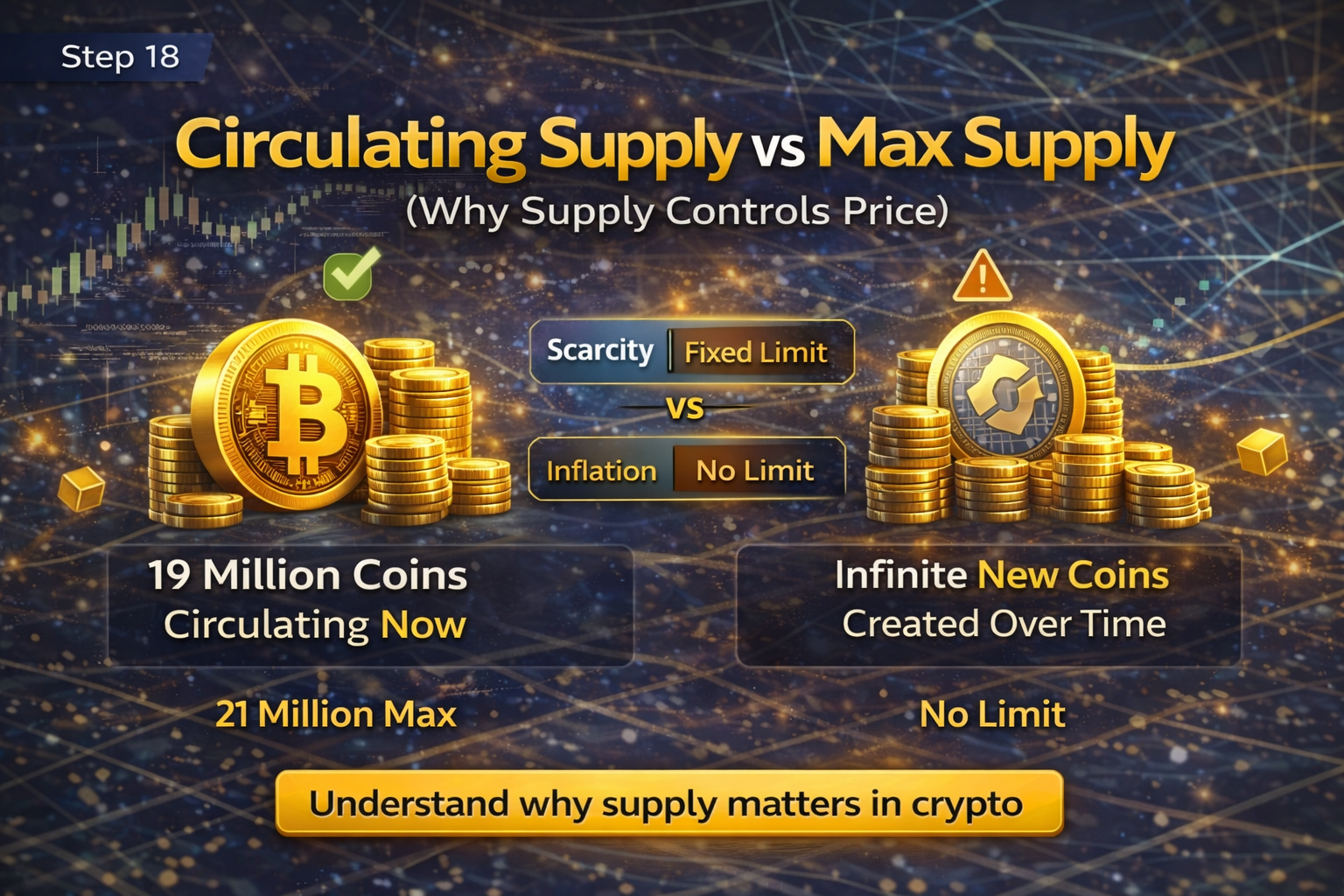
Now that you understand market cap, the next concept that heavily affects a cryptocurrency’s price is supply.
Many beginners focus only on price and ignore how many coins actually exist.
But supply is extremely important because it affects how scarce a cryptocurrency is and how its price can move over time.
Two key terms you’ll see in crypto are:
• Circulating Supply
• Maximum Supply
Understanding these will help you evaluate whether a cryptocurrency has strong long-term potential or hidden inflation risks.
What Is Circulating Supply?
Circulating Supply refers to the number of coins that are currently available and actively trading in the market.
These are the coins that investors can buy, sell, and trade right now.
Example:
Bitcoin currently has over 19 million coins in circulation.
That means roughly 19 million BTC are available in the market today.
Circulating supply is important because it is used in the market cap calculation.
Market Cap = Price × Circulating Supply
What Is Maximum Supply?
Maximum Supply is the total number of coins that will ever exist.
Some cryptocurrencies have a fixed maximum supply, while others do not.
Example:
Bitcoin has a maximum supply of 21 million coins.
This means no more than 21 million BTC will ever be created.
Because of this limit, Bitcoin is often compared to digital gold, since scarcity can increase value over time.
Why Supply Matters in Crypto
Supply plays a major role in how a cryptocurrency’s price behaves.
If a coin has a very large supply, each individual coin will likely have a lower price.
For example:
A project with 1 trillion coins will naturally have a much lower price per coin than a project with 21 million coins, even if both projects have the same market cap.
This is why price alone does not determine value.
Market cap and supply together tell the real story.
Inflation vs Scarcity
Another important concept is whether a cryptocurrency’s supply keeps increasing over time.
Some cryptocurrencies continuously create new coins through mining or staking rewards.
This is called inflation.
If too many new coins enter the market, it can put downward pressure on price.
Other cryptocurrencies have a limited supply, which can create scarcity.
Scarcity can make an asset more valuable if demand increases.
Example: Bitcoin vs Inflationary Coins
Bitcoin
• Max supply: 21 million
• Fixed supply
• Scarcity built into the system
Some altcoins
• No maximum supply
• New coins constantly created
• Potential long-term inflation
This doesn’t automatically make inflationary coins bad, but it does mean investors should understand how the supply works.
Key Takeaway
When evaluating a cryptocurrency, always check:
• Circulating Supply – how many coins exist today
• Maximum Supply – how many will exist in the future
• Whether the supply is fixed or inflationary
These factors play a huge role in how a cryptocurrency’s price and market cap evolve over time.
Understanding supply helps investors avoid misleading price comparisons and evaluate projects more intelligently.
Next Step
Now that you understand market cap and supply, the next concept is tokenomics.
Tokenomics explains how a crypto project distributes its tokens and how the system is designed economically.
👉 Up next:
🔗 Step 19 – Tokenomics Explained