

📘 Crypto Guides & How-To Course
Step 12 of 16
In this step, you’ll learn why supply matters more than hype — and how misunderstanding supply causes beginners to massively overestimate a coin’s potential.
This lesson is NOT about trading.
It’s about understanding scarcity, inflation, and long-term value so you don’t fall for misleading price predictions.
⬅️ Previous: Step 11 – Market Cap vs Price (Why Cheap Coins Aren’t Cheap)
➡️ Next: Step 13 – Fully Diluted Valuation Explained (FDV)
If supply terms confuse you, you’re not alone.
Most beginners hear things like:
- “This coin is only $0.01!”
- “It can easily hit $1!”
- “It’s cheap right now!”
But price without supply context is meaningless.
Here’s the truth 👉 Supply determines how high (or low) a price can realistically go.
Let’s break it down in simple English.
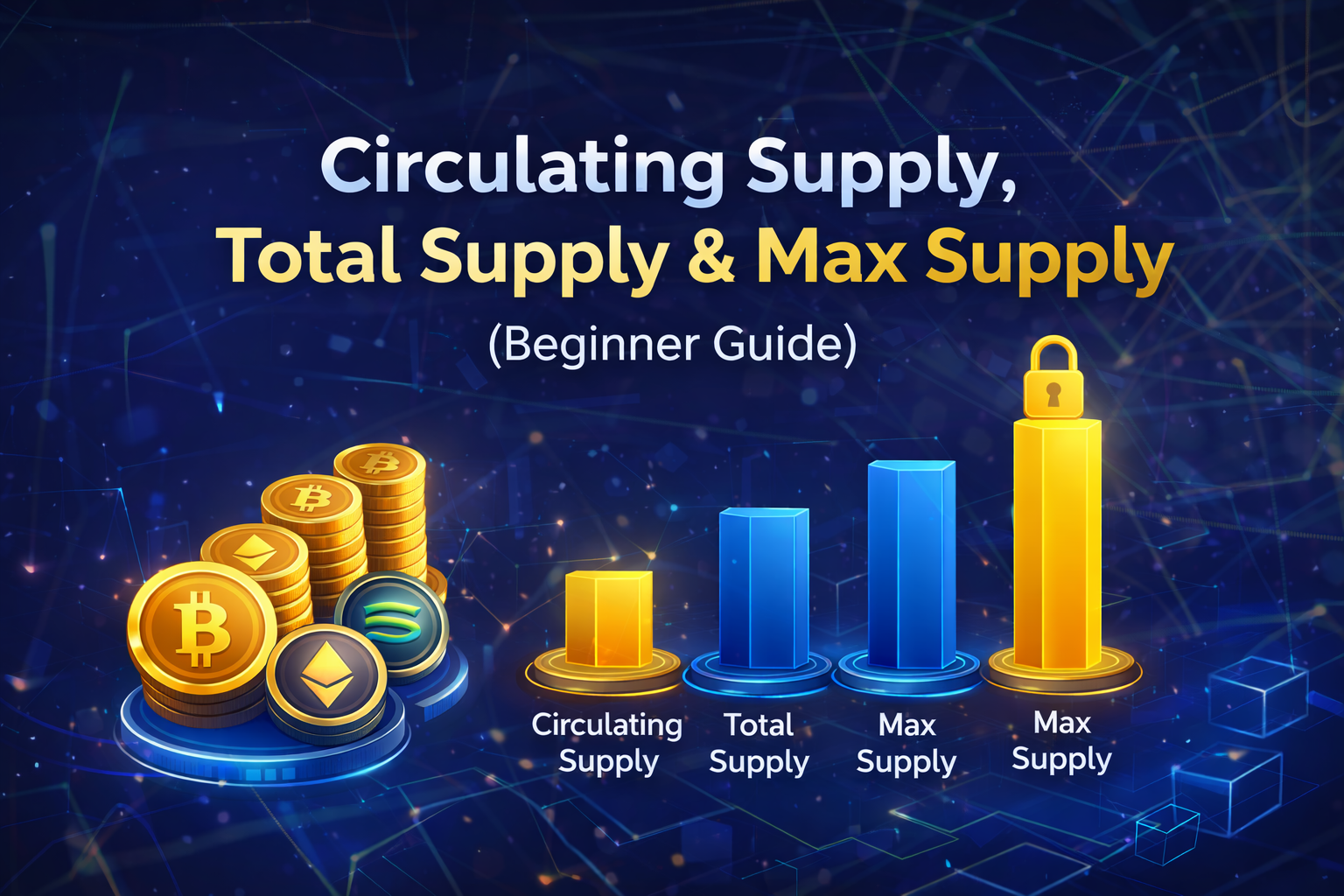
🔑 The 3 Types of Crypto Supply (Explained Simply)
1️⃣ Circulating Supply
This is the number of coins currently available and trading in the market.
👉 Think of it as:
Coins that already exist and can be bought or sold today
2️⃣ Total Supply
This is the number of coins that exist now or will exist in the future, minus any that were destroyed (burned).
👉 Think of it as:
Coins created so far + coins still locked or reserved
3️⃣ Max Supply
This is the hard cap — the maximum number of coins that can ever exist.
👉 Think of it as:
Absolute limit (no more coins can be made)
Not all cryptocurrencies have a max supply.
🧠 Why This Matters (A Simple Example)
Let’s compare two imaginary coins:
Coin A
- Price: $0.05
- Circulating Supply: 10 billion coins
Coin B
- Price: $500
- Circulating Supply: 19 million coins
Even though Coin A looks “cheap,” it would need hundreds of billions of dollars to reach $1.
Coin B already has scarcity, which supports higher prices.
👉 Cheap price does NOT mean high potential.
⚠️ Common Beginner Mistakes With Supply
❌ Ignoring how many coins exist
❌ Assuming all coins can reach Bitcoin prices
❌ Not checking max supply
❌ Falling for “$0.01 to $100” hype
Supply protects you from unrealistic expectations.
🧩 Quick Rule to Remember
✔️ Price × Supply = Market Cap
✔️ Supply determines scarcity
✔️ Scarcity supports value
✔️ Unlimited supply = inflation risk
If you understand supply, you already know more than most beginners.
✅ What You’ve Learned in Step 12
✔️ The difference between circulating, total, and max supply
✔️ Why low price alone means nothing
✔️ How supply limits future price growth
✔️ How to avoid hype-driven mistakes
➡️ Next Up:
Step 13 – Fully Diluted Valuation (FDV) Explained (Beginner Guide)
Wealthy Affiliates (Create your own business )