
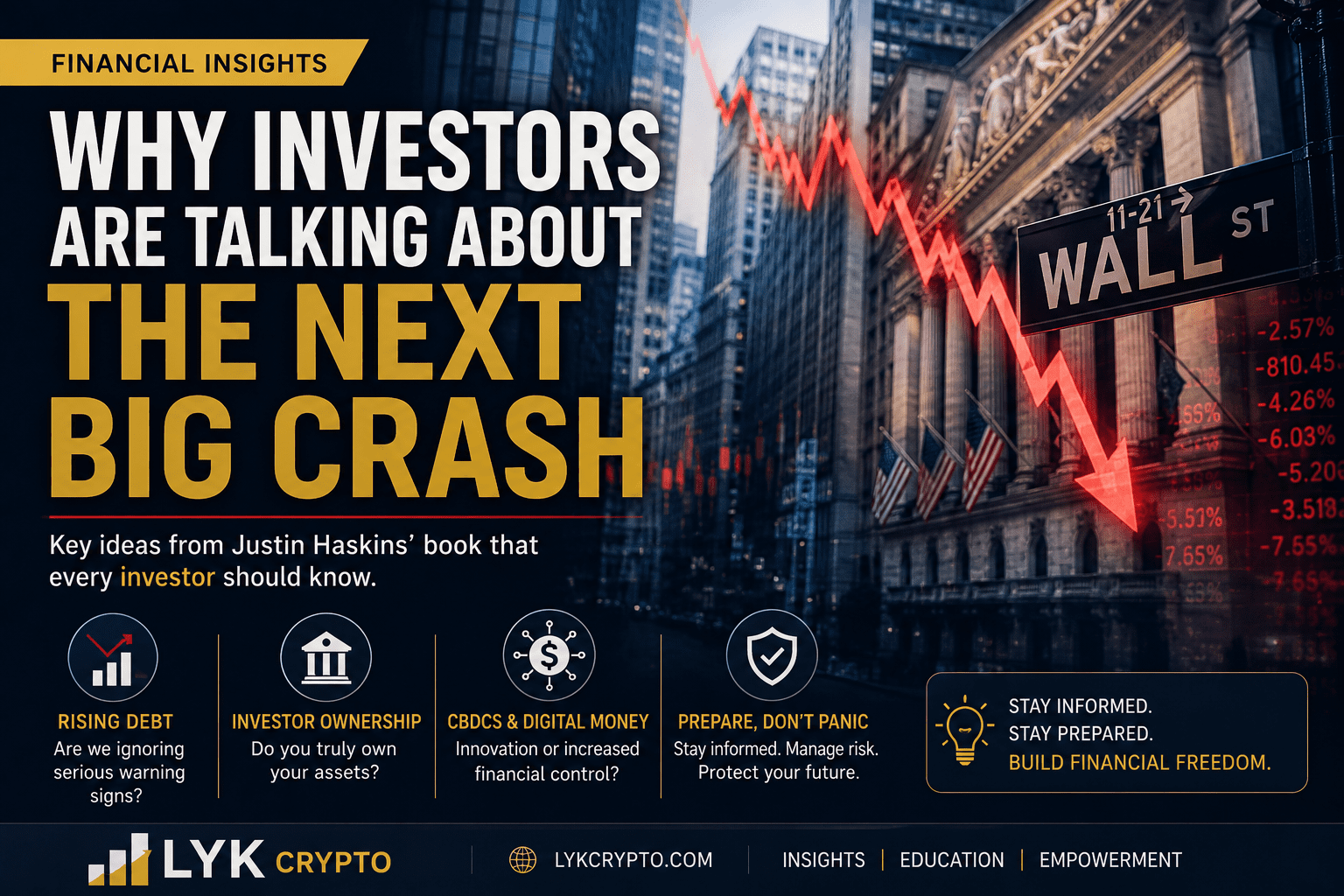
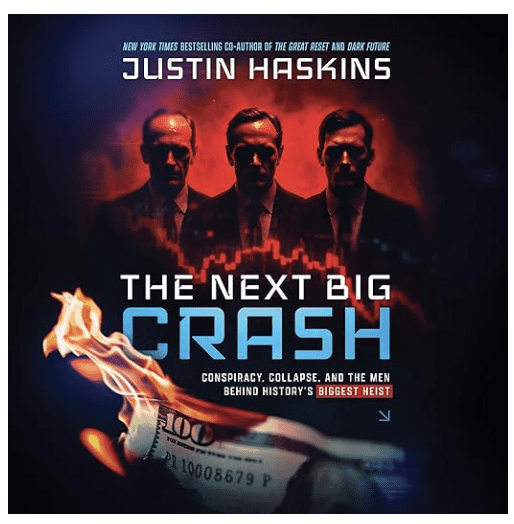
A friend of mine who follows financial markets closely recently sent me a YouTube discussion about the book The Next Big Crash by Justin Haskins. The conversation raised several interesting points about the economy, investing, debt, and the future of financial systems that immediately caught my attention.
I haven’t read the full book yet, but the discussion was interesting enough that I wanted to learn more and share some of the major topics currently being discussed around it.
One of the key themes mentioned is the growing concern over rising national debt, inflation, economic instability, and how modern financial systems may be evolving faster than many everyday investors realize.
Another major topic discussed is the future of Central Bank Digital Currencies (CBDCs) and digital financial systems. Supporters believe these technologies could modernize banking and payments, while critics believe they could potentially create new concerns surrounding privacy, centralized oversight, and financial control.
The discussion also explored questions surrounding investor ownership, market structure, and how financial assets are managed inside large institutional systems.
Whether every concern raised turns out to be accurate or not, I personally believe these are important conversations worth paying attention to.
History has shown that financial stress can build quietly before becoming visible to the public.
From:
• The Dot-Com Bubble
• The 2008 Housing Crisis
• Inflation spikes
• Bank failures
• Market volatility
Each period reminded investors why financial education, diversification, and risk management matter.
One thing that stood out to me from the discussion was the importance of not relying entirely on a single asset class or financial system.
Many experienced investors often talk about the importance of diversification, including:
• Owning a mix of investments
• Not having everything tied only to stocks
• Real estate and property ownership
• Precious metals like gold and silver
• Maintaining emergency savings
• Continuing financial education
No investment is completely risk-free, but understanding different asset classes and staying educated can help people make more informed long-term decisions.
At LYKcrypto, the goal is not fear or panic — it’s education, awareness, and learning how financial systems continue to evolve in both traditional markets and digital assets.
Education is one of the most valuable investments a person can make.
I’m planning to read The Next Big Crash myself soon so I can better understand Justin Haskins’ full perspective directly from the source rather than only hearing conversations about it online.
If you’ve already read the book, I’d genuinely like to hear your thoughts.
Do you believe investors should be more concerned about long-term economic risks?
Or do you believe financial systems today are stronger and more resilient than in the past?
Best Place to store your Crypto.( LEDGER Affiliate link)
👇 Share your thoughts in the comments.
━━━━━━━━━━━━━━━
📚 Interested in learning more about the book?
━━━━━━━━━━━━━━━
Disclosure: This article may contain affiliate links. If you purchase through these links, LYKcrypto may earn a small commission at no extra cost to you.
Disclaimer: This article is intended for commentary, educational, and discussion purposes only and does not represent financial advice or claims about the author’s views beyond publicly discussed topics.
I most certainly feel that people should be very concerned about their Investments and currently who holds their assets. I’m a strong believer that the disruption that cryptocurrency has caused mainly evolves around that who holds the assets. It becomes more of a challenge for financial institutions to hold all the control themselves because anyone from anywhere on the planet can gain the assets of cryptocurrency anytime in any place as well as they can transfer it anytime in any place. Whereas the banks can give you a limit upon how much money you can withdraw crypto won’t do that the banks can charge you monthly if they want maintenance fees where crypto wallets won’t do that. There are other things that you can hold on to like your precious metals rather than allowing institutions to hold it for you because for all you know they might not even have possession of it but they’re telling you that they do. That’s just my two cents.
Very well said, and thank you for taking the time to share such a thoughtful perspective. 👏
One of the biggest reasons cryptocurrency has become such a disruptive force is exactly what you mentioned — ownership and control. For the first time in history, everyday people can truly hold and transfer value globally without needing permission from traditional financial institutions. That concept alone changes the entire conversation around money and assets.
I also agree that diversification and self-custody are becoming increasingly important topics. Whether it’s crypto, precious metals, or other assets, many people are starting to question how much control they really have when everything is held through third parties.
At the same time, education and responsibility are critical because with greater freedom also comes greater personal responsibility and security. This space is evolving fast, and discussions like this are exactly why it’s important for people to stay informed and think critically.
Appreciate you adding value to the conversation!
Being a full-time trader, this talk about the next big crash feels pretty real to me. Markets have shown over and over that nothing stays safe for good. That’s why diversification isn’t just a buzzword; it’s a lifeline.
What stood out in your post is the reminder that financial stress often builds quietly before it becomes visible. That’s exactly when diversification and risk management prove their worth.
Do you think diversification strategies should now include digital assets like Bitcoin or CBDCs, given how quickly financial systems are evolving, or should investors stick to more traditional hedges like gold and real estate?
Excellent perspective, especially coming from someone who trades the markets full-time. You understand better than most how quickly “safe” can turn into vulnerable once sentiment shifts and liquidity dries up. That point you made about financial stress building quietly before becoming obvious is incredibly important and honestly one of the core reasons I wrote the post.
As for diversification, I personally think the definition of diversification itself is evolving. Traditional hedges like gold, real estate, cash flow assets, and even commodities still absolutely have a place because they’ve stood the test of time through multiple economic cycles. But at the same time, ignoring digital assets entirely may eventually become just as risky as overexposing yourself to them.
Bitcoin, in particular, has forced the financial world to rethink concepts like decentralized ownership, inflation resistance, and global transferability. CBDCs are interesting too, but in a very different way. To me, Bitcoin represents decentralization and individual control, while CBDCs could represent increased centralization and monitoring within the financial system. That contrast alone makes this transition period fascinating.
I think the smartest investors moving forward will likely be the ones who stay balanced, adaptable, and educated rather than emotionally attached to only one system or asset class. Diversification today may no longer just mean “stocks and bonds” — it may mean spreading risk across traditional assets, digital assets, liquidity, and even self-custody strategies.
Really appreciate you adding such a strong and thoughtful perspective to the discussion.
Today, I find that it’s a growing number of financial voices that are appropriately raising serious questions about rising national debt, inflation, and the rapid shift toward digital currencies, and whether everyday people are paying close enough attention. History has shown that economic stress rarely announces itself, and by the time most people notice, the window to prepare has often already closed. A great simple and straight forward introductiuon. Should be an eyeopener for many.
Thank you, I truly appreciate your thoughtful feedback. You made an excellent point — throughout history, major economic shifts rarely come with a clear warning sign for the average person. By the time the majority realizes what’s happening, many opportunities to prepare or adapt have already passed.
That’s exactly why conversations around national debt, inflation, digital currencies, and financial independence are becoming more important than ever. Whether people agree or disagree on the direction things are heading, staying informed and paying attention to these changes is critical.
I’m glad the article came across as simple and straightforward because my goal is to help everyday people start thinking deeper about these topics without making it overly complicated or fear-driven. Sometimes all it takes is one “eye-opening” moment for someone to begin learning and preparing more seriously for the future.
Really appreciate you taking the time to share your perspective and contribute to the discussion.