

At this point, you understand:
• Risk management
• Support & resistance
• Market structure
• Position sizing
Now we’re going to talk about something even more powerful:
Psychology.
Because the market doesn’t just move on logic.
It moves on human emotion.
And most traders don’t lose because of bad strategy…
They lose because of fear and greed.
The Market Is Driven by Emotion
Prices move because of:
• Fear
• Greed
• Hope
• Panic
• FOMO (Fear of Missing Out)
• Herd mentality
When you see a coin pumping fast…
People aren’t calmly analyzing fundamentals.
They’re chasing.
When you see a crash…
People aren’t logically evaluating value.
They’re panicking.
Understanding this gives you a huge edge.
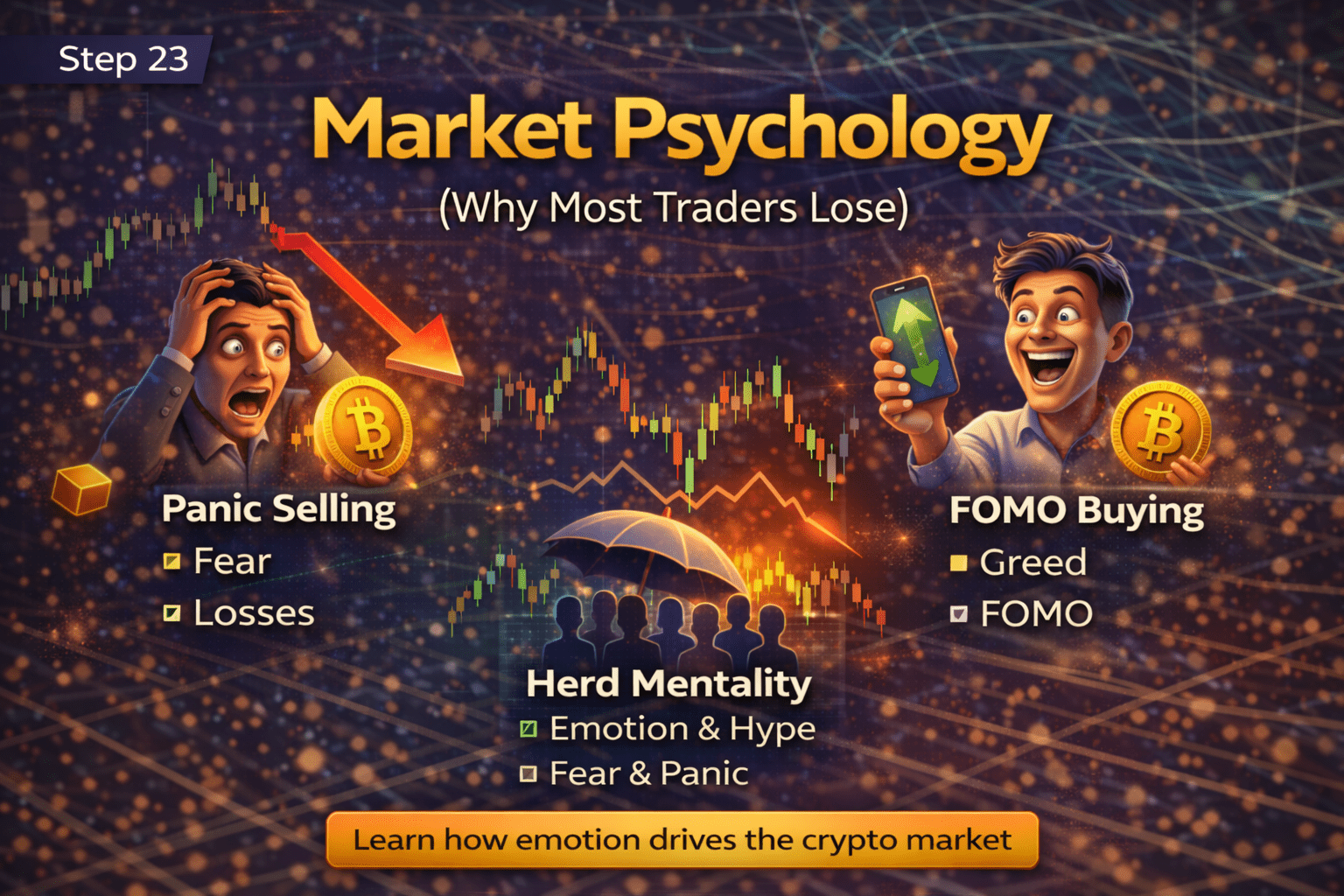
FOMO (Fear of Missing Out)
FOMO is one of the biggest wealth destroyers in crypto.
It sounds like:
• “It’s going to $10,000!”
• “Everyone is buying!”
• “I’m going to miss the move!”
So beginners buy after a big pump…
Right before the correction.
Smart investors wait.
They don’t chase green candles.
Panic Selling
The opposite of FOMO is panic.
When price drops:
• News turns negative
• Social media gets loud
• Fear spreads
Beginners sell at the bottom because they can’t handle the emotional pressure.
Experienced traders understand:
Markets move in cycles.
Corrections are normal.
The Herd Mentality
Most people feel safer doing what everyone else is doing.
If everyone is bullish, you feel bullish.
If everyone is bearish, you feel scared.
But markets often reverse when the crowd becomes extreme.
When everyone thinks it can only go up…
That’s usually near the top.
When everyone thinks it’s over…
That’s often near the bottom.
The Smart Investor Mindset
Successful traders think differently.
They:
• Plan trades before entering
• Accept losses calmly
• Avoid emotional decisions
• Stick to risk management rules
• Don’t need to catch every move
They understand:
You don’t need to trade constantly.
You need to trade intelligently.
Emotional Discipline > Perfect Strategy
You can give two people the same strategy.
One will succeed.
The other will fail.
The difference?
Emotional control.
The market rewards patience, discipline, and consistency — not excitement.
How to Improve Your Trading Psychology
Here are practical habits that help:
• Risk small amounts
• Set stop losses in advance
• Avoid overtrading
• Don’t check price every 5 minutes
• Journal your trades
• Accept that losses are part of the game
The more structured your plan, the less emotion controls you.
Key Takeaway
The market is a battlefield of emotion.
If you control your psychology, you control your results.
Most beginners fight the market.
Smart traders manage themselves.
That’s the real edge.
Next Step
Now that you understand psychology…
It’s time to learn how to build a real plan.
👉 Step 24 – Building a Simple Trading Strategy
Because discipline works best when it follows a clear system.