

You’ve learned:
• Market structure
• Support & resistance
• Risk management
• Market psychology
Now it’s time to put everything together.
Because knowledge without a system leads to random decisions.
And random decisions lead to random results.
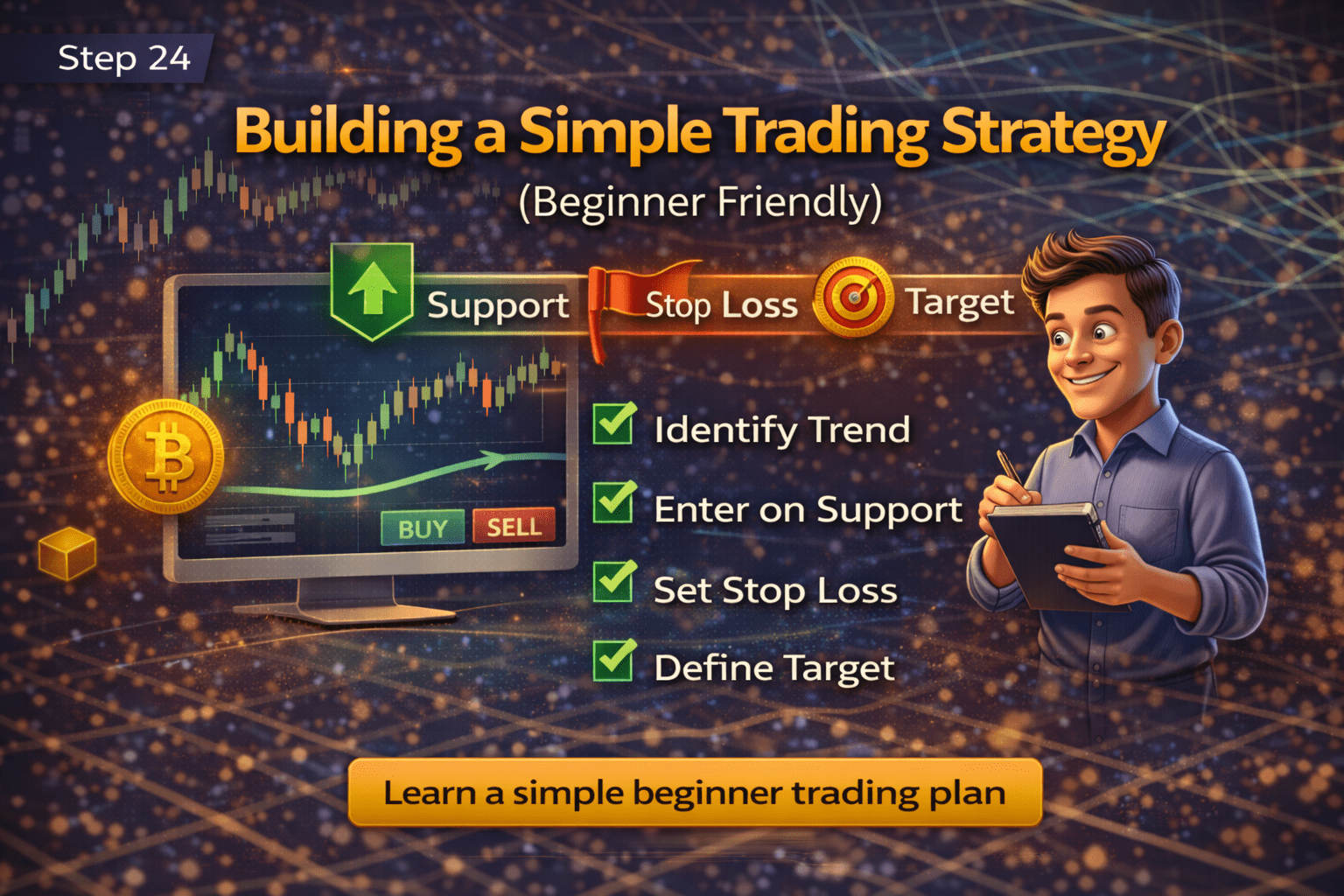
Today, you’ll learn how to build a simple, beginner-friendly trading strategy.
What Is a Trading Strategy?
A trading strategy is a clear plan that answers:
• When do I enter?
• When do I exit?
• How much do I risk?
• Why am I taking this trade?
Without a strategy, you are reacting.
With a strategy, you are executing.
Step 1: Choose Your Market Type
First, identify the market environment:
• Uptrend (higher highs & higher lows)
• Downtrend (lower highs & lower lows)
• Sideways (range-bound)
Example beginner rule:
👉 Only trade long (buy) in an uptrend.
This alone filters out many bad trades.
Step 2: Use Support & Resistance for Entries
Instead of chasing price:
Wait for price to return to:
• Support in an uptrend
• Resistance in a downtrend
This improves your entry and reduces risk.
Example:
Uptrend confirmed
Price pulls back to support
You enter near support
Stop loss below support
That’s structured trading.
Step 3: Define Your Stop Loss Before Entry
Before entering ANY trade, decide:
Where is my invalidation point?
If support breaks, your idea was wrong.
That’s where the stop loss goes.
Never move your stop because you “hope” it turns around.
Discipline > Hope.
Step 4: Define Your Target
Where will you take profit?
Common beginner approach:
• Risk 1%
• Aim for 2–3% reward
This is called risk-to-reward ratio.
If your reward is bigger than your risk, you don’t need to win every trade to be profitable.
Step 5: Risk Small & Stay Consistent
This is where most people fail.
They:
• Break their own rules
• Double their risk after a loss
• Get emotional after a win
A strategy only works if you follow it consistently.
Example Simple Beginner Strategy
Here’s a very basic template you can follow:
1️⃣ Trade only in an uptrend
2️⃣ Wait for pullback to support
3️⃣ Risk 1–2% per trade
4️⃣ Stop below support
5️⃣ Target 2–3x your risk
6️⃣ No revenge trading
That’s it.
Simple beats complicated.
Why Simplicity Wins
Beginners often think:
“More indicators = better results.”
But too many indicators cause:
• Confusion
• Delays
• Emotional second-guessing
A clean chart + structure + risk management is enough.
Professionals don’t chase complexity.
They execute consistency.
Key Takeaway
A strategy removes emotion.
When you know:
• Why you’re entering
• Where you’re exiting
• How much you’re risking
You trade with clarity — not impulse.
The market rewards discipline, not excitement.
Next Step
Now that you have a strategy framework…
It’s time to understand how to evaluate performance and grow long-term.
👉 Step 25 – Long-Term Portfolio Growth & Compounding
This is where traders become investors.