

Now that you understand market cycles, the next concept that helps traders understand price movement is Support and Resistance.
These are two of the most important concepts in trading because they help explain where price tends to stop, bounce, or reverse.
Support and resistance are not perfect predictions, but they are areas where buyers and sellers often react.
Understanding these levels helps traders avoid buying at the worst possible time or selling too early.
What Is Support?
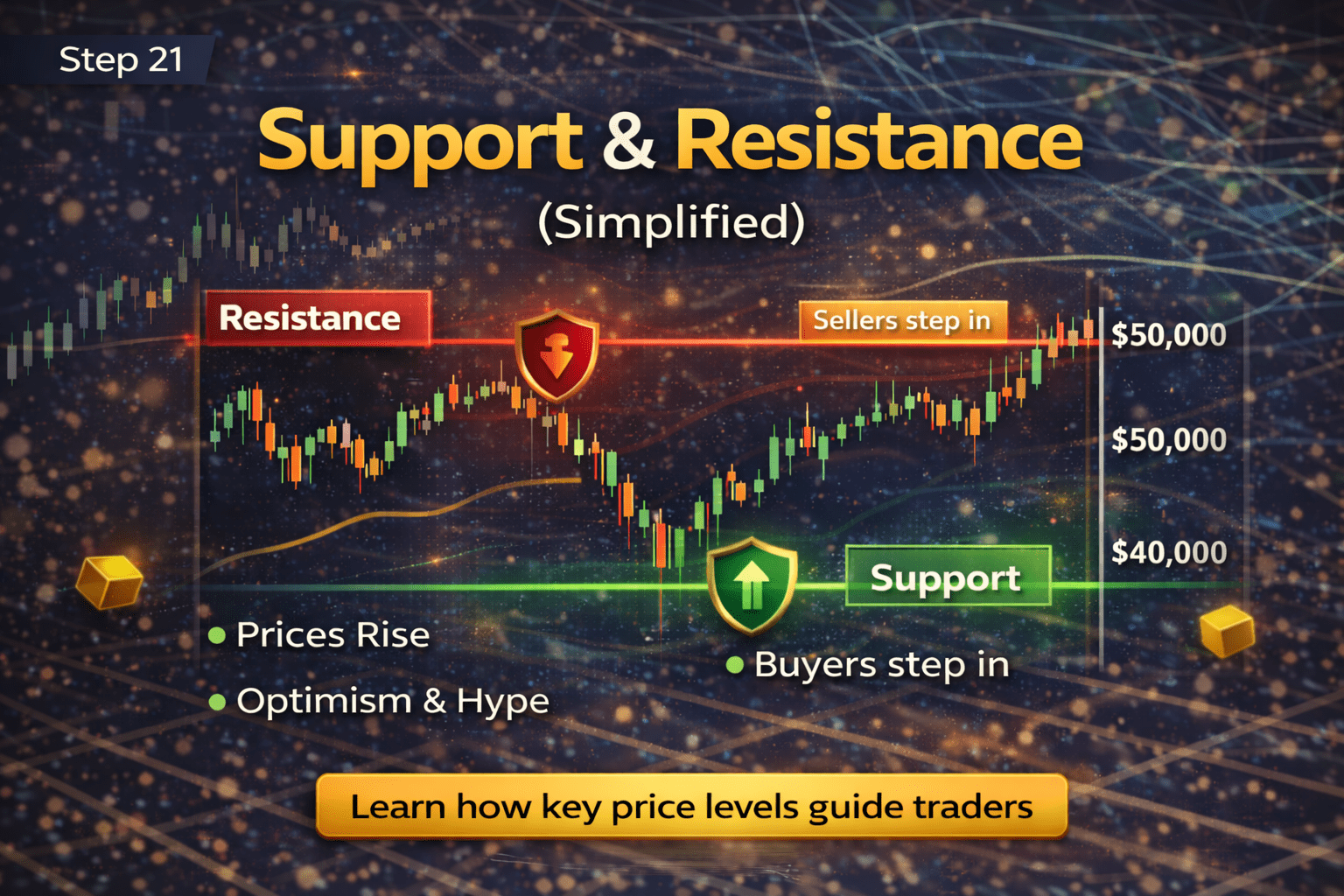
Support is a price level where a cryptocurrency tends to stop falling and may start rising again.
This happens because buyers begin stepping in and purchasing the asset at that level.
Think of support as a floor that price often bounces from.
Example:
If Bitcoin repeatedly falls to $40,000 and then rises again, that level may act as support.
Traders watch these levels closely because they can indicate potential buying opportunities.
What Is Resistance?
Resistance is the opposite of support.
It is a price level where a cryptocurrency tends to stop rising and may start falling.
This happens when many investors decide to sell their coins at that price level.
Think of resistance as a ceiling that price struggles to break through.
Example:
If Bitcoin repeatedly rises to $50,000 but struggles to move higher, that level may act as resistance.
When price approaches resistance, traders often become more cautious.
Why These Levels Matter
Support and resistance work because many traders are watching the same price levels.
When enough people react at the same point, it can create noticeable patterns in the market.
These levels can help traders:
• Identify potential entry points
• Manage risk more effectively
• Avoid chasing price during emotional moves
While these levels are not guaranteed, they are widely used tools for understanding market behavior.
When Support Becomes Resistance
One interesting thing about these levels is that they can switch roles.
If price breaks below a strong support level, that level may later act as resistance.
Likewise, if price breaks above resistance, that level may later act as new support.
This happens because traders remember these price levels and often react to them again.
Key Takeaway
Support and resistance are tools that help traders understand where price may react.
Support acts like a floor, where buyers step in.
Resistance acts like a ceiling, where sellers appear.
While these levels don’t guarantee outcomes, they can help traders make more informed decisions instead of reacting emotionally.
Next Step
Now that you understand how traders analyze price levels, the next lesson focuses on something even more important:
👉 Risk Management
This concept is what separates successful traders from beginners who lose money quickly.
🔗 Step 22 – Risk Management